
SAFETY & AUTOMATION
Smarter control for safer operations
Gas safety and automation systems bring detection, control and response together, helping industrial teams operate with greater visibility and confidence.
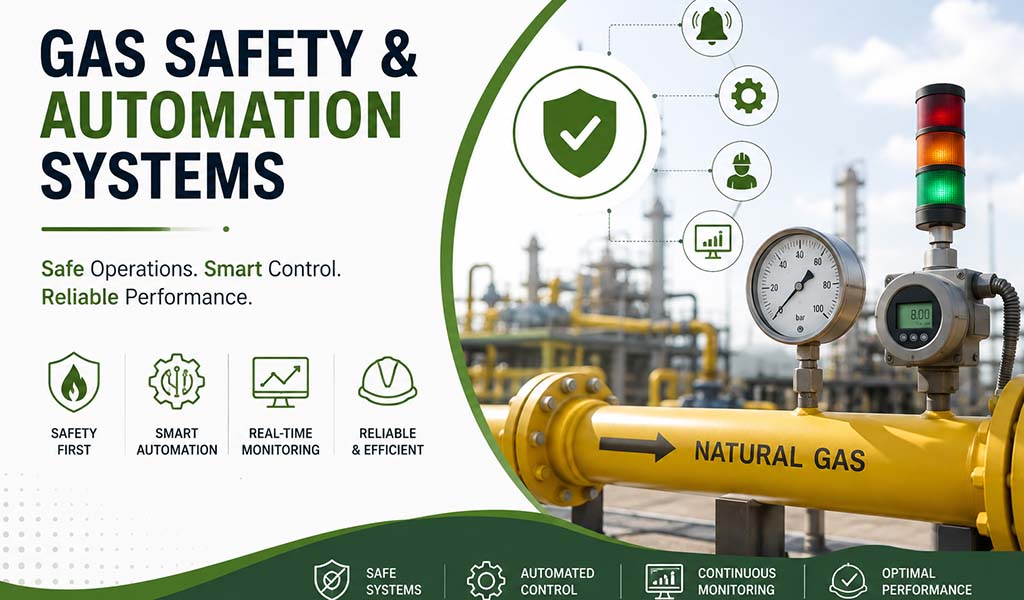
Reliable pipelines and equipment are only part of an industrial gas installation. Operators also need continuous monitoring, clear information and dependable controls to recognise abnormal conditions and respond promptly.
Gas safety and automation systems connect detection, alarms, interlocks and automated shutdown functions with day-to-day process control. When designed around the installation, they help teams manage gas operations more consistently and identify issues before they develop into larger operational problems.
Why gas safety systems matter
Natural Gas, CBG, LPG, RLNG and other industrial gases require safety measures suited to their properties and operating conditions. Leakage, pressure changes, equipment faults and process deviations can affect both plant safety and productivity.
A gas safety system may combine several functions:
- Gas leak detection to identify abnormal gas concentrations.
- Pressure monitoring to reveal deviations from intended operating conditions.
- Visual and audible alarms to give operators a clear warning.
- Safety interlocks and emergency shutdown to initiate the actions defined by the system design.
- Ventilation controls where required by the installation.
Equipment selection and configuration should follow the specific gas, process conditions, applicable standards and site requirements.
Automation for better gas management
Automation brings instruments, sensors, control panels and PLC-based logic into a coordinated control environment. Operators can monitor gas pressure, flow, temperature and equipment status with a clearer picture of how the installation is performing.
Alarm management, equipment sequencing and safety interlocks can be incorporated into the control philosophy. This reduces reliance on repetitive manual intervention and supports consistent operation.
For larger facilities, monitoring and control can connect with plant-level SCADA or other supervisory systems. The integration depends on project requirements, but its purpose is straightforward: give operating teams access to the information they need to make informed decisions.
The benefits of an integrated system
Designing safety and automation together helps the installation function as a coordinated system. Detection, operator information and control actions can work toward the same operating objectives.
- Earlier awareness: monitoring and alarms help teams identify abnormal situations sooner.
- Better operational control: centralised process information supports consistent decisions and responses.
- Fewer avoidable interruptions: early warnings and better visibility can help minimise unplanned disruption.
- Coordinated gas handling: connected controls reduce dependence on isolated equipment and manual processes.
These capabilities are relevant across gas pipeline networks, PRMS and metering stations, CBG grid injection, compressor and booster installations, filtration systems, and RLNG or LPG handling facilities.
An engineering-led approach
Greentech Group starts with the process requirements, operating conditions and safety objectives. Instrumentation, control logic, monitoring, alarms and integration are then planned around practical operation and reliability.
This approach draws on the group’s work across Natural Gas and CBG systems, pipeline networks, pressure reduction and metering, filtration and conditioning, RLNG and LPG handling, and compressor and booster integration.
The aim is gas infrastructure that supports safe, efficient and dependable operation today, with provision for future expansion and automation requirements.
Explore the equipment and integration behind this approach.
Gas Safety and Automation Systems