
NATURAL GAS & CBG
Engineering a cleaner energy future
From dependable gas supply to renewable fuel from organic waste, well-engineered systems connect energy ambitions with practical industrial operation.
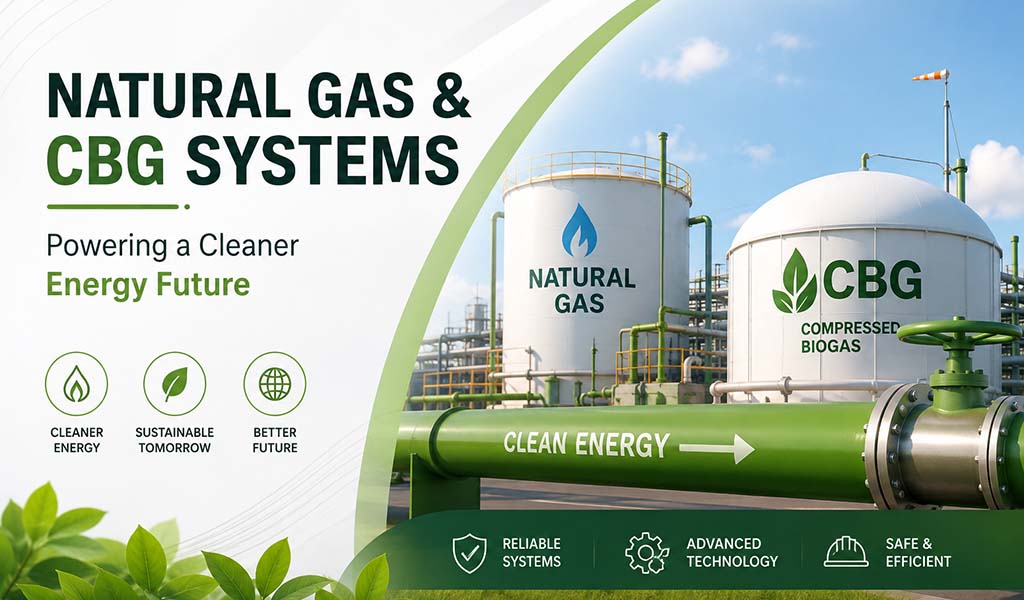
As industries consider cleaner and more efficient energy options, Natural Gas and Compressed Biogas (CBG) systems have an important role in how gaseous fuels are processed, handled and used.
Reliable gas infrastructure needs more than individual pieces of equipment. It brings engineering, safety, process efficiency and long-term operational reliability together. Understanding the fuel and its intended use is the starting point.
Understanding Natural Gas systems
Natural Gas systems handle and deliver gas for industrial and commercial applications. The configuration depends on the installation, but may include pressure regulation, filtration, metering, compression, distribution pipework, controls and safety equipment.
The engineering objective is to maintain stable pressure and flow while meeting the needs of manufacturing facilities, process industries, utilities and other gas-based applications.
A dependable installation also considers how people will operate and maintain it. Accessible equipment, practical controls and coordinated safety functions are important for facilities that rely on a continuous gas supply.
From organic waste to CBG
Compressed Biogas is a renewable fuel made by processing and upgrading raw biogas from organic materials. Feedstocks can include agricultural residue, cattle dung, municipal organic waste, sewage sludge and food waste.
After suitable purification and upgrading, the methane-rich gas can have characteristics similar to conventional CNG and serve industrial, transport and gas-network applications, subject to the requirements of its intended use.
A typical CBG system brings together several stages:
- Biogas generation: producing raw biogas from the available organic feedstock.
- Gas cleaning: removing impurities and managing moisture.
- Upgrading: separating carbon dioxide to improve the methane content.
- Compression and handling: preparing the upgraded gas for its intended application.
Raw biogas contains methane alongside carbon dioxide, moisture, hydrogen sulphide and other impurities. Gas purification and upgrading are essential steps before compression and final use.
Benefits and room to grow
Natural Gas provides a dependable energy option for many industrial processes. CBG adds the opportunity to turn organic waste into useful renewable fuel and reduce reliance on conventional fossil fuels.
Using suitable waste streams for CBG production can support waste management and create value from agricultural, municipal and industrial organic materials. It connects energy production with a more circular use of resources.
Plant capacity should reflect the practical conditions of the project. Modular or scalable arrangements can be selected around:
- The quantity and availability of feedstock.
- The required gas output and intended application.
- Future expansion plans and integration requirements.
Matching these factors early helps align the system design with the resources available and the operation it needs to support.
Engineering for dependable operation
Greentech Group’s approach to Natural Gas and CBG systems focuses on efficiency, reliability, safety and practical project requirements. Gas handling, purification, compression, controls and system integration are considered as connected parts of the installation.
The aim is to build infrastructure that supports dependable operation and long-term performance. As industrial energy needs evolve, professionally engineered systems can help translate fuel-transition plans into workable installations.
From the initial process requirements to the final control interfaces, careful integration helps prepare gas infrastructure for both current demand and future development.
Continue reading about the controls that support dependable gas infrastructure.
Smarter control for safer operations